Business networking has always been built around relationships. A conversation at a conference, a handshake at an exhibition, a meeting with a prospective client, or the exchange of a business card can become the beginning of something valuable. Yet, despite the importance of these interactions, the way businesses manage them has changed very little for decades.
A business card is exchanged, contact details are stored, and everyone moves on to the next conversation. Days later, the card may be sitting inside a wallet, a drawer, a spreadsheet, or a phone contact list. The meeting is remembered, but the opportunity created by that meeting is often not.
This is the traditional networking blind spot.
The problem is not that businesses lack contacts. In fact, most professionals and organizations have more contacts than ever before. The challenge is knowing which relationships matter, what happened after an interaction, when to follow up, and whether those connections are actually contributing to business growth.
This is where DigitalWall represents a new evolution in business networking: the shift from simply exchanging contact information to building Business Interaction Intelligence.
From Paper Business Cards to Digital Relationships
For years, the business card has been one of the simplest tools for professional networking. It provides essential information such as a person's name, designation, company, phone number, email address, and website. But a printed card is static. It cannot remind someone to follow up. It cannot show whether a connection engaged with a profile. It cannot be updated instantly when a person's role changes. Most importantly, it cannot provide any insight into what happened after the card was exchanged.
Digital networking changes this equation.
A digital business identity can remain active long after a meeting ends. Instead of handing over a piece of paper that may eventually be misplaced, professionals can share a digital presence that can contain their contact information, professional identity, social links, business details, and other relevant information.
But DigitalWall goes beyond the concept of a digital business card.
The larger opportunity lies in connecting the entire networking journey — from the moment two people meet to what happens after that interaction.
The Missing Link Between Networking and Business Growth
Networking is often measured by volume. Businesses count how many people attended an event, how many business cards were collected, or how many new contacts were added.
But these numbers do not necessarily indicate business value.
A company might collect hundreds of business cards at an exhibition and still generate very little revenue from the event. Another company might make only a few highly relevant connections and convert several of them into customers or long-term partnerships.
The difference is often what happens after the initial interaction.
Without a structured process, follow-ups are easily forgotten. Important conversations become difficult to recall. Contact information becomes scattered across different systems. Sales teams may have no clear visibility into which leads came from which event. Over time, potentially valuable relationships can disappear simply because there was no consistent way to continue them.
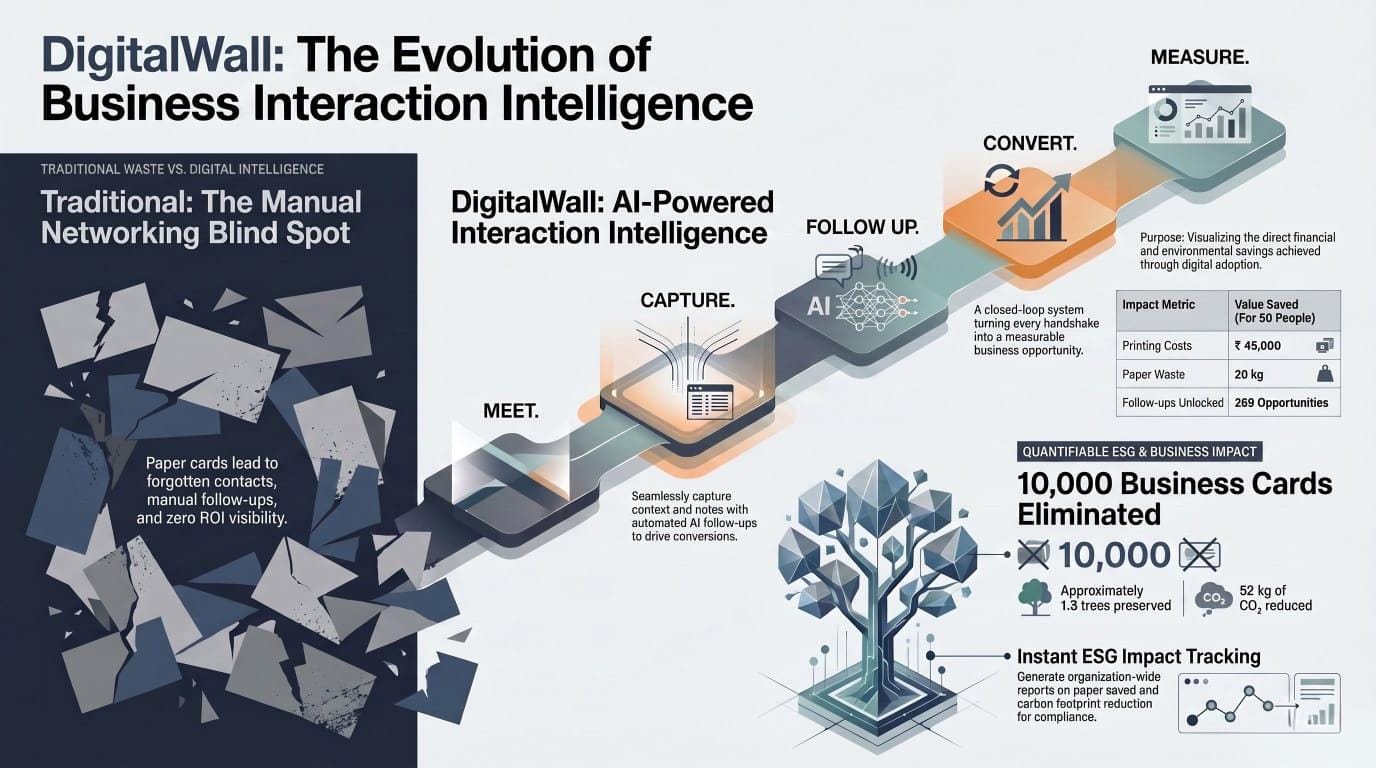
DigitalWall approaches this challenge by turning networking into a connected journey.
The journey begins when people meet. Their information can then be captured digitally, organized for future interaction, and supported through structured follow-up. As relationships develop, businesses can work toward conversion, while analytics and engagement data provide greater visibility into the overall value of their networking activity.
In other words, networking can evolve from a one-time exchange into a continuous business process.
Capturing the Value of Every Interaction
One of the biggest challenges in networking is contact capture.
At a major conference, trade exhibition, or business event, professionals may meet dozens or even hundreds of people in a short period. Manually entering every contact into a database is time-consuming, and relying entirely on memory is even less reliable.
DigitalWall helps bridge this gap by bringing contact capture and digital networking together. Business cards can be digitized, information can be organized, and connections can become part of a structured digital ecosystem rather than remaining as isolated pieces of paper.
This matters particularly for sales professionals, consultants, entrepreneurs, exporters, exhibitors, and business development teams whose work depends heavily on maintaining relationships.
The objective is not simply to collect more contacts.
It is to make every contact more useful.
Follow-Up Is Where Networking Becomes Business
The most important part of networking often begins after the event is over.
A conversation at a conference may generate interest in a product. A meeting with a potential partner may require another discussion. A prospective customer may be waiting for a proposal. A new connection may introduce an opportunity several months later.
Without follow-up, all of these possibilities can remain unrealized.
This is why networking should not stop at contact capture.
DigitalWall helps users maintain visibility over their relationships through digital profiles, contact management, notes, reminders, and interaction-focused tools. Instead of relying on memory or scattered spreadsheets, professionals can create a more structured approach to maintaining business relationships.
The fundamental shift is simple.
Traditional networking asks, "Who did I meet?"
Intelligent networking asks, "Who did I meet, what happened next, and what should I do now?"
That difference can have a significant impact on business development.
From Follow-Up to Conversion
Every networking interaction has the potential to become something more.
A new contact can become a customer. A conversation can become a partnership. A business introduction can become a referral. A meeting at an exhibition can eventually become a long-term commercial relationship.
However, conversion does not happen simply because contact information was exchanged.
It requires continuity.
When businesses can capture interactions, organize contacts, maintain follow-ups, and understand engagement, they have a better foundation for turning relationships into opportunities.
This is the principle behind Business Interaction Intelligence: connecting the different stages of networking so that interactions do not disappear into disconnected contact lists.
DigitalWall brings these stages together into a more measurable ecosystem, helping businesses move from meeting people to understanding and developing the relationships created through those meetings.
Why Business Interaction Intelligence Matters for Corporates
For large organizations, the networking challenge becomes even more complex.
A corporate organization may have sales representatives attending exhibitions, marketing teams participating in conferences, senior executives building strategic partnerships, and business development teams meeting prospects across different markets.
Each team generates valuable relationship data.
But when that information remains distributed across individual phones, spreadsheets, paper cards, messaging applications, and disconnected systems, the organization loses visibility into its collective networking activity.
DigitalWall provides a digital framework that can help organizations bring greater structure to these interactions.
Instead of treating networking as an individual activity, businesses can begin viewing it as an organizational asset.
The result is a shift from isolated networking to a more connected relationship ecosystem, where digital identities, contact capture, engagement, follow-up, and analytics can work together.
A Practical Opportunity for MSMEs
For small and medium-sized businesses, relationships can be even more critical.
An introduction to the right customer can open a new market. A supplier connection can improve operations. A referral can bring in new business. A conversation with another entrepreneur can lead to a valuable partnership.
Yet MSMEs often operate with limited teams and limited time. Managing hundreds or thousands of business relationships manually can quickly become difficult.
DigitalWall gives MSMEs an opportunity to bring networking into a more structured digital environment without treating every interaction as a separate administrative task.
Instead of collecting business cards and hoping to remember whom to contact later, businesses can create a more systematic process for capturing, organizing, following up, and developing their professional relationships.
Measuring What Networking Actually Delivers
One of the biggest changes brought by digital networking is the ability to think beyond contact collection.
Businesses can begin asking more meaningful questions about their networking activity.
How many people were engaged? Which connections continued after an event? Which profiles received attention? Which interactions resulted in opportunities? Which networking activities generated meaningful engagement?
These questions move networking from a purely qualitative activity toward something that can be observed and measured.
This is particularly important for organizations that invest significant resources in conferences, exhibitions, trade events, corporate networking, and business development activities.
If a company spends money to participate in an event, the value should not be measured only by the number of visitors who passed through its booth.
The real value lies in what happens to those relationships afterward.
Digital Networking and the ESG Advantage
The move away from physical business cards also creates an opportunity to rethink the environmental impact of networking.
Large conferences, exhibitions, and corporate events can involve thousands of printed business cards. While an individual card may appear insignificant, the cumulative volume across organizations and events can become substantial.
Digital alternatives reduce the dependence on physical cards and allow professional information to be shared electronically.
The DigitalWall infographic illustrates this concept through the potential impact of eliminating 10,000 printed business cards, showing how digital adoption can contribute to reduced printing costs, lower paper consumption, and measurable environmental benefits.
The exact savings will naturally vary according to printing specifications, paper usage, and organizational practices. Nevertheless, the broader message is important: digital transformation does not have to be limited to efficiency and convenience. It can also support sustainability objectives.
The Future Is Not About Collecting More Contacts
The future of business networking will not necessarily belong to the company with the biggest contact database.
It will belong to the organizations that understand their relationships better.
Having thousands of contacts means very little if a business does not know who its most valuable connections are, when to engage with them, or how previous interactions contributed to business outcomes.
The evolution from paper business cards to digital identities is therefore only the beginning.
The next step is understanding the interaction itself.
Who did you meet? What information was exchanged? What was discussed? Did the connection continue? Was there a follow-up? Did the relationship create an opportunity? Did that opportunity eventually contribute to business growth?
These are the questions that transform networking from a collection exercise into a business intelligence function.
From Handshakes to Intelligence
Business relationships have always started with human interaction.
Technology does not replace that interaction. It makes it easier to capture, continue, understand, and build upon.
DigitalWall represents this shift from traditional networking to Business Interaction Intelligence by bringing together digital identity, business card scanning, contact management, networking, follow-up, engagement, and analytics.
The objective is not simply to eliminate paper business cards.
It is to eliminate the gap between meeting someone and building a meaningful business relationship with them.
The traditional model ends with the exchange of a card.
The modern model begins there.
With DigitalWall, every handshake can become more than a moment of interaction. It can become a structured, measurable opportunity for connection, engagement, and growth.
Because the real value of networking is not the number of business cards you collect. It is what you do with the relationships after the meeting.
Explore DigitalWall
DigitalWall helps professionals and businesses digitize networking, strengthen relationships, improve visibility, and turn business interactions into measurable opportunities.
Explore DigitalWall and move from traditional networking to Business Interaction Intelligence.